5E's original Starter Set, Lost Mine of Phandelver is still a great way to start a D&D campaign
Published: January 01, 0001
Most of the introductory adventures written to ease new players into Dungeons & Dragons over the years have been pretty rough. They're often just dungeon crawls, which might teach you the rules for combat and disarming traps, but don't bother demonstrating what's actually exciting about roleplaying games. Which is the roleplaying. Even when beginner modules leave the dungeon, they tend to dump a lot of work in a young Dungeon Master's lap.
Take . This introductory module from 1979 gave players a home base in the Keep of the title, full of NPCs they might want to befriend and do business with, and not one of them had a name. They were just job titles like "the provisioner" and "the castellan", with a sentence of description if you were lucky. , published the same year, did a slightly better job providing a detailed location full of characters you might want to have a conversation with, though even that spent more time telling you how many gold and silver pieces every villager owned and where they hid them than who they actually were.
Lost Mine of Phandelver quickly becomes a sandbox, with some obvious influence from open world videogames. There's a clear distinction between the main questline—where you're trying to rescue a dwarf and rediscover a mine with a magical forge in it—and a string of optional sidequests. Some of the questgivers turn out to be members of factions like the Harpers and Zhentarim, which you can join once you've proven your worth in a very Oblivion touch. (It would seem unrealistic if you found out how many townsfolk are members of these factions, but in play any given group is likely to only discover the ones relevant to their characters.)
Lost Mine still gives you what you expect from a classic D&D game. One of the first challenges you face is a cave full of goblins, real level-one stuff, but with plenty of personality. The goblins have two leaders, and depending which way they explore, the PCs might end up deciding one's the lesser evil and siding with him to defeat the other. It's not just a bunch of rooms with bad guys in them—though some of the later dungeons do slip into that—it's a space where players can express their characters. Do you try to sneak past the wolves, tame them, or kill them before they alert the goblins? Do you trust the goblin who offers to free a captive if you kill the bugbear he's got beef with?

Elsewhere, Lost Mine serves up classic monsters like skeletons, zombies, and a level-appropriate beholder subtype, along with a few unusual picks for flavor like a nothic (a one-eyed psychic cannibal) and a grick (a snake with a beak that splits open like the Predator's face). Then, for dessert, there's a dragon.
Every time I put a dragon in a game of D&D someone says they've never actually fought a dragon in D&D, even though they're in the name of Yono all app the game. I get it, people want to avoid the clichés. I hardly ever put dungeons in my games because there are more interesting places to tell stories, but dragons are worth it because they get an elemental reaction out of proportion with how tough they are—there are monsters with higher stats that make less impact, because they're not dragons, man.
The dragon in Lost Mine is part of a sidequest that feels designed to be a capstone to the campaign, a higher-level challenge for players to work toward. (The main questline's final dungeon even has dragon-proof magic armor you'll want to collect beforehand.) Like several other encounters in Lost Mine it doesn't have to be a fight to the death—the dragon will flee once you've taken most of its hit points. Last time I ran it the party's wizard dropped but was healed just before dying, and the dragon escaped with a handful of hit points. It seems like an insurmountable challenge for adventurers who've just hit level five, but is actually carefully balanced.

The first encounter in Lost Mine's really the toughest—an ambush that makes ordinary goblins a valid threat by having them start in hiding with ranged weapons. The temptation must have been to write a tutorial fight that's not a real threat, but this brutal opener works perfectly. It makes the players realize how dangerous battles can become, and they'll want to find alternatives to combat from then on. (There's a get-out-of-jail-free card in that the goblins want captives and will take the PCs prisoner if they fall, meaning you won't actually have your first game end with everybody dying in scene one because they rolled bad.)
All that stuff's great, but it's got to be said one of the main strengths of the Starter Set is that it was cheap and readily available. It got D&D into big-box retailers like Wal-mart and Target alongside Monopoly and at an affordable price, which I suspect is as much a reason for 5E's success as the popularity of Critical Role or The Adventure Zone (who played Lost Mine in their first episodes, but infuriatingly skipped most of the good bits and sounded like they had a miserable time, though it did end hilariously).

That said, Lost Mine isn't perfect. For all the personality it gives Phandalin's NPCs, helped by a section of bullet points that ease a beginner DM into hamming it up, there are curious gaps. Both the main questgiver, a dwarf called Gundren Rockseeker, and the mysterious dark elf who serves as the overall villain, are complete blanks. You have to decide what their whole deal is for yourself. The pregenerated characters, while perfect for beginning players who in my experience find thinking up a character from scratch one of the most intimidating parts of RPGs, have links to the sidequests in their backstories that are never referenced in the adventure text. And the last dungeon, the Lost Mine all yono app itself, is a bit boring—too long and with an underwhelming showdown against a drow wizard who can easily be taken apart by any group of adventurers.
What mitigates these flaws is the sandbox nature of Lost Mine. Hardly anybody runs prewritten adventures exactly as they're laid out, and this freeform structure makes it particularly easy to tweak. I imagine even a first-time DM would feel comfortable making significant changes by the time they get to the end, which is where the biggest changes should be made.
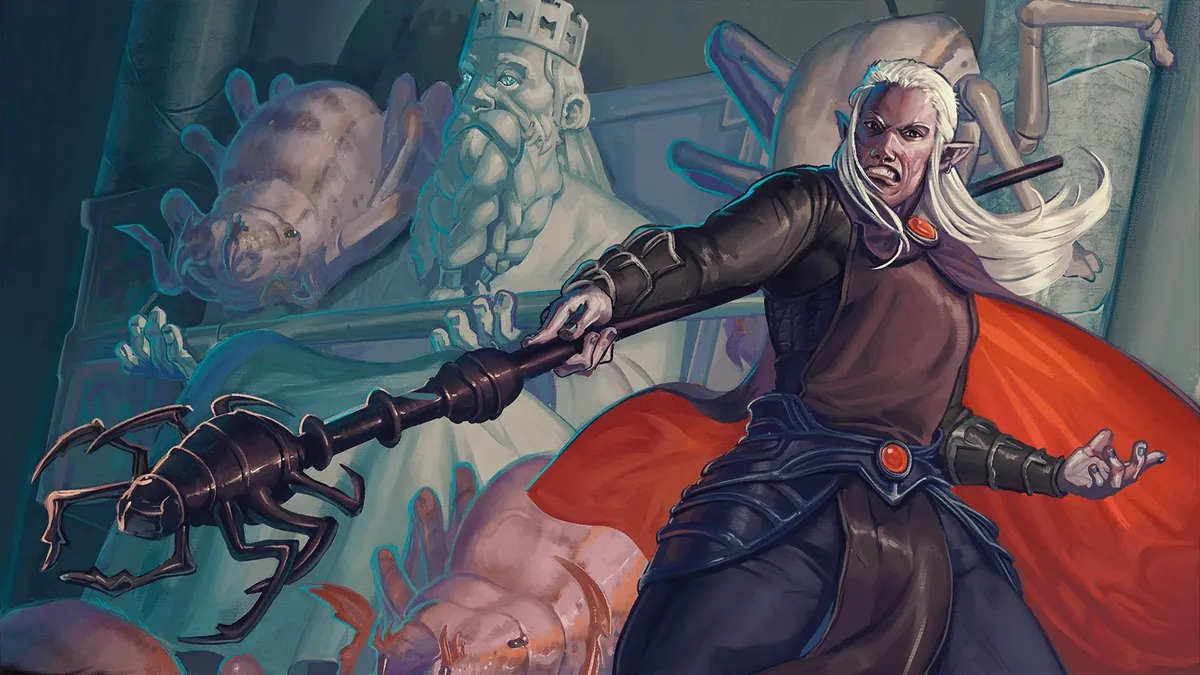
That final dungeon contains your dark elf nemesis and his minions, as well as a bunch of undead who want to drive go rummy out intruders. While you can negotiate with the wraith who leads the undead, you can't fully make them your allies. Which is no fun at all, especially when the very first dungeon taught you to divide and conquer. I let successful parleying result in a band of ghouls following the heroes around, helping them in combat then creepily devouring fallen enemies. Having allies balanced out because I was already planning to beef up the finale by giving the drow a second phase—at zero hit points the voice of Lolth the Spider Queen decried his failure, cursed him, and turned him into a . It made
him a more significant threat, and gave the dungeon a memorable climax.
There's one more flaw with Lost Mine's status as a solid introduction to D&D, and that's the fact you can't buy it any more. (Though there are plenty of secondhand copies floating around.) It's been replaced by a different Starter Set and a , and was reprinted, but as the first part of a longer campaign in a hardcover book called The Shattered Obelisk.
The expanded reprint does include more artwork for some of the NPCs, which is always useful for showing players, but rather than extending the original—building on potential conflicts between the factions in Phandalin now that a profitable magic mine has opened down the road—it throws in a completely new threat whose minions are goblins with psychic powers. And while I just praised Lost Mine for ticking the goblins-in-a-cave box, by its end your players will be ready for some variety. Just turning on the goblin "big head mode" cheat doesn't really cut it.

The Shattered Obelisk makes changes to the text of Lost Mine as well, and this is where it gets trickier to criticize. Those changes include rewriting some of the NPCs to make more of them women, and a couple of them sympathetic portrayals of orcs and drow, which meant the usual suspects on social media got to score a few new followers by decrying it as woke or DEI or whatever they're saying now.
While obviously that's a nonsensical criticism—the second time I ran Lost Mine I used Shattered Obelisk's versions of the NPCs to add a couple more women to the town and the world didn't end—not all of the changes are for the better. Or even consistent. The dwarf bar owner who becomes an orc reverts to a dwarf in a later chapter, and useful sections on roleplaying Phandalin's NPCs and the description of the town hall are missing.
It's a shame the original version of the Starter Set, complete with its pregenerated character sheets, isn't as easy to find as it was back when it was on the shelf of every big-box retailer. It's still floating around, though—you can get it on and it was available for free on for so long that if you're a habitual collector of anything with a zero-dollar sign on it like me, you may already own a copy.
Recommended Reading
I grew up watching films from the aptly named Disney Renaissance—I'm talking The Hunchback of Notre Dame, Hercules, and Mulan—and then got to [[link]] enjoy some bangers like Treasure Planet, Brother Bear, and...
The Super Mario Bros. speedrunner Niftski has achieved a new world record for the classic Nintendo title on a PC emulator, setting a time of 4:54.565 in the "any%" category. You may well be [[link]] wondering ...
Recent updates July 22: In a statement to PC Gamer, The Chinese Room revealed that last month's layoffs at the company and the ones reported by Game Developer were [[link]] one and the same. In the initial ve...
Comments (3)
I enjoy the daily missions and rewards system. It gives me extra motivation to play regularly and allows me to earn more coins and bonus items, which enhances the overall gaming experience.
Website layout is very clean, intuitive, and easy to navigate. I can quickly find my favorite games, access promotions, and check my account details without any confusion. It’s a pleasure to use.
Some games take a while to load on mobile, but once they start, the gameplay is smooth and exciting. I hope future updates improve mobile performance, but I still enjoy playing several hours a day.